
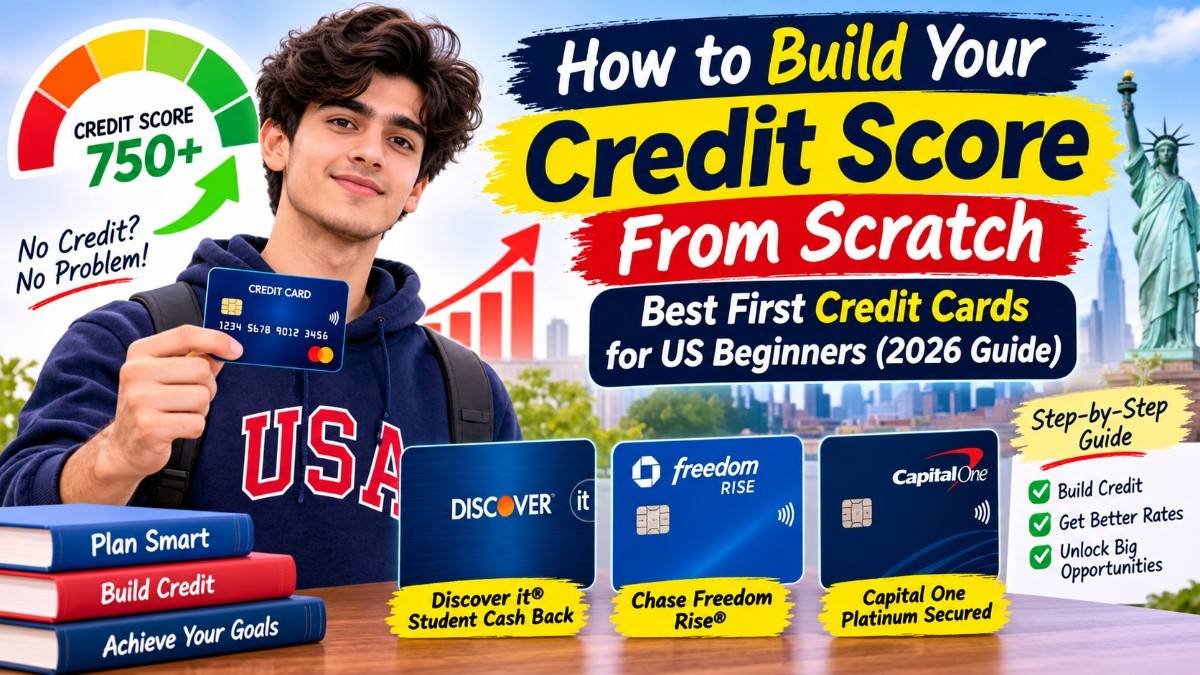
Introduction: Your Credit Score Is Your Financial Passport in America
Imagine moving to the United States, starting your first job, and saving money for an apartment. You have income, a bank account, and plans for the future, but when you apply for a credit card or car loan, the lender cannot find enough credit history to evaluate you. This is a common challenge for college students, immigrants, and young adults who are beginning their financial journeys.
In the US, your credit history can influence whether you qualify for credit cards, auto loans, mortgages, and certain apartment rentals. It can also affect the interest rates or security deposits you may be offered. Think of your credit score as a financial passport. It does not define your financial worth, but it can help lenders evaluate how you have managed borrowed money. The good news? You do not need an established credit score to start building credit history.
In this guide, you will learn how to build your credit score from scratch, understand the habits that matter most, and compare three beginner credit cards worth researching in 2026.
Learning how to build your credit score from scratch starts with choosing the right account, making payments on time, and keeping your credit utilization low.
Table of Contents
What Does It Mean to Have No Credit Score?
Before applying for your first credit card, understand one important difference: having no credit history is not the same as having a low credit score. If you have no credit history, credit bureaus may not have enough qualifying information to generate a score under a particular scoring model. If you have a low score, there is enough information to calculate a score, but your credit history may contain factors that lenders consider risky.
Your first goal is to establish accounts that report qualifying activity to the major credit bureaus. Over time, responsible account management can help you develop a positive credit history. However, no particular score or approval is guaranteed.
Why Does Your Credit Score Matter?
Your credit history can play a role in several financial decisions:
- Apartment rentals: Some landlords review credit reports when screening applicants.
- Car loans: Lenders may use your credit profile to assess eligibility and interest rates.
- Credit cards: Issuers review your application information and credit history when deciding whether to approve you.
- Mortgages: Lenders generally evaluate credit alongside income, debt, assets, and other requirements.
- Utilities and insurance: Depending on the provider and applicable state laws, credit-based information may affect certain deposits or insurance decisions.
Having no credit score does not automatically mean you will be rejected. Some landlords and financial providers consider alternative documentation, such as proof of income, rental references, or additional deposits. Nevertheless, starting early can help you build a stronger financial foundation.
The Golden Rules of Building Credit From Scratch
You do not need to memorize every credit-scoring formula. Focus on a few simple habits that can help you establish and maintain a positive credit history.
Rule 1: Always Pay Your Bills on Time
Payment history is one of the most important factors in many widely used credit-scoring models. When you use a credit card, the issuer generally reports account information to one or more credit bureaus. Your payment behavior can become part of the information used to evaluate your creditworthiness. A seriously late payment can damage your credit profile, so make on-time payments a priority from the beginning.
Here is a simple system:
- Set up automatic payments for at least the minimum amount due.
- Add your payment deadline to your calendar.
- Keep enough money in your checking account to cover scheduled payments.
- Whenever possible, pay the full statement balance by the due date.
Paying the full statement balance can help you avoid interest on ordinary purchases when your card’s grace-period requirements are satisfied. Automatic payments are useful, but check your account regularly to make sure payments are processed successfully.
Rule 2: Keep Your Credit Utilization Low
Credit utilization measures how much of your available revolving credit you are using. The formula is simple:
Credit utilization = Credit card balance ÷ Credit limit × 100
Imagine your first credit card has a $500 limit. If your balance is $100, your utilization is 20%. If your balance reaches $400, your utilization is 80%.
High utilization can negatively affect many credit scores, even if you make your payments on time. A commonly recommended guideline is to keep utilization below 30%. However, lower utilization may be beneficial under some scoring models, and 30% is not a universal cutoff. For a $500 credit limit, 30% equals $150. You do not need to spend $150 every month or carry a balance to build credit. Instead, use your card for affordable purchases and pay your statement balance in full whenever possible.
Also, understand that your reported balance may reflect the amount owed at a particular point in the billing cycle. Paying down a balance before the statement closes may reduce reported utilization, but you must still meet your payment deadline.
Rule 3: Give Your Credit History Time to Grow
A positive credit history develops through consistent behavior, not overnight tricks. Scoring models may consider payment history, account age, utilization, and other information. The exact factors and their weight vary by scoring model. Start with one suitable account and manage it responsibly. You do not need several credit cards to begin building credit. Keep an account open when it makes financial sense, considering its fees, benefits, and terms.
Rule 4: Check Your Credit Reports
Your credit report contains information about your credit accounts and payment history. Review your reports periodically to look for incorrect balances, unfamiliar accounts, or inaccurate payment information. You can obtain your credit reports through AnnualCreditReport.com, the federally authorized website for free credit reports. Checking your own credit report does not, by itself, create a hard inquiry. If you find an error, follow the relevant credit bureau’s dispute process and provide supporting documentation.
One of the most effective ways to build your credit score from scratch is to use credit responsibly and pay your statement balance on time.
Top 3 Starter Credit Cards for Beginners in 2026
Choosing your first credit card can feel overwhelming when you have little or no credit history. Some cards focus on rewards, while others prioritize credit building. The right choice depends on your eligibility, spending habits, and ability to manage the card responsibly.
Here are three options to compare using the supplied product details.
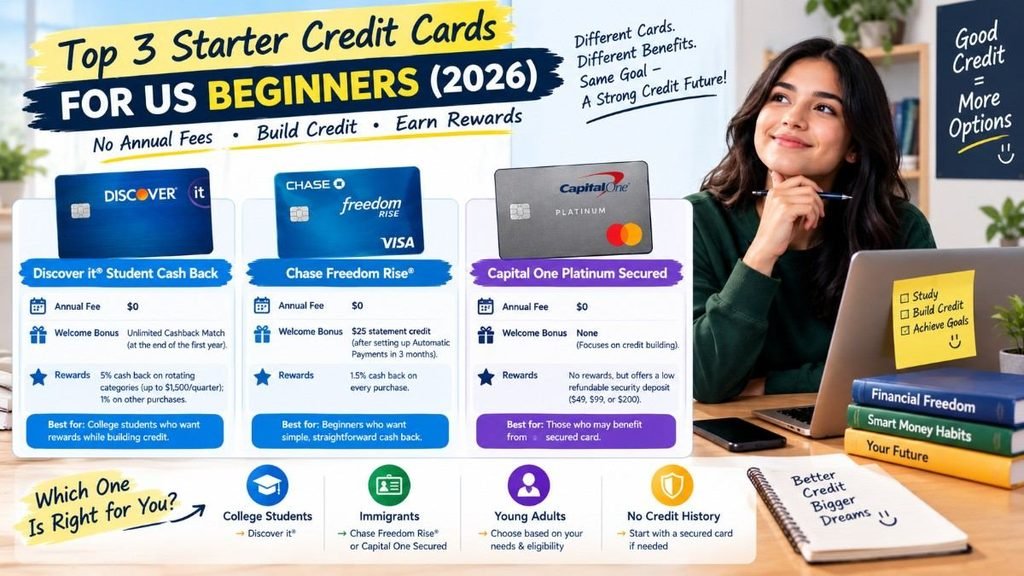
Credit Card Comparison Table
| Feature | Discover it® Student Cash Back | Chase Freedom Rise® | Capital One Platinum Secured |
| Annual Fee | $0 | $0 | $0 |
| Welcome Bonus | Unlimited Cashback Match at the end of the first year | $25 statement credit after enrolling in Automatic Payments within the first 3 months | None |
| Rewards | 5% cash back on rotating quarterly categories, up to $1,500 in spending per quarter after activation; 1% on other purchases | 1.5% cash back on every purchase | No rewards |
| Security Deposit | No security deposit for approved applicants | No security deposit for approved applicants | Refundable deposit of $49, $99, or $200 for a $200 initial credit line, depending on creditworthiness |
| Notable Feature | First-year Cashback Match | A Chase checking account with a $250+ balance may improve approval odds, according to the supplied details | Automatic credit line reviews starting in as little as 6 months |
| Best For | Eligible students who want cash-back rewards | Beginners who prefer straightforward cash back | Applicants who prefer a secured credit card |
Important: Card offers, rewards, eligibility requirements, and approval criteria may change. Verify current terms on the issuer’s official website before applying. Approval is not guaranteed.
1. Discover it® Student Cash Back
The Discover it® Student Cash Back card is designed for eligible college students who want to establish credit while earning rewards on everyday purchases. It has a $0 annual fee and offers 5% cash back on rotating quarterly categories after activation, up to $1,500 in spending per quarter. Purchases outside those categories earn 1% cash back under the supplied terms. Its welcome offer is Unlimited Cashback Match. Discover automatically matches the cash back earned during the first year at the end of that year, subject to the offer’s terms.
For example, if you earn $100 in eligible cash back during your first year, a matching offer could provide another $100 at the end of the period. This card may be worth researching if you are an eligible college student who wants rewards while building credit. Before applying, check the current eligibility rules, interest rate, and offer details.
2. Chase Freedom Rise®
The Chase Freedom Rise® card offers a straightforward rewards structure for beginners who prefer not to track rotating categories. It has a $0 annual fee and offers 1.5% cash back on every purchase under the supplied terms. Its welcome offer includes a $25 statement credit after enrolling in Automatic Payments within the first three months, subject to the offer’s conditions.
The supplied information also indicates that opening or holding a Chase checking account with a balance of $250 or more may improve approval odds. This is not a guarantee, and applicants must still meet the issuer’s requirements. This card may be worth comparing if you want simple cash-back rewards and meet the current application requirements.
3. Capital One Platinum Secured
A secured credit card may be useful for someone who has limited credit history and does not qualify for an unsecured card. The Capital One Platinum Secured card has a $0 annual fee under the supplied terms. It does not offer rewards because its primary focus is credit building. The supplied information lists refundable security deposits of $49, $99, or $200 for a $200 initial credit line, depending on creditworthiness. Your actual deposit and approval terms depend on the issuer’s decision.
The card also offers automatic credit line reviews starting in as little as six months, according to the supplied information. A review does not guarantee a credit line increase. This card may be worth researching if you can comfortably set aside the required deposit without using money needed for rent, food, tuition, or emergencies.
Which First Credit Card Should You Choose?
If you are an eligible college student who wants rotating-category rewards, consider researching Discover it® Student Cash Back. If you prefer a straightforward cash-back structure, compare Chase Freedom Rise® and its current application requirements. If you are considering a secured card, Capital One Platinum Secured may be worth investigating because it focuses on credit building rather than rewards. Compare the deposit, reporting practices, and current terms with other available secured cards before making a decision.
Do not choose a credit card based on rewards alone. For beginners, affordable spending, reliable payments, and manageable fees matter much more than earning a small amount of cash back.
How Immigrants Can Start Building US Credit
Moving to the United States can mean starting your financial life with little or no US credit history. Even if you had a strong credit score in another country, US lenders may not automatically use it. Credit-reporting systems and lender requirements vary across countries. Fortunately, there are practical ways to get started.
Understand the Identification Requirements
Depending on the issuer and product, an application may request a US residential address, date of birth, income information, and a Social Security number or another permitted taxpayer identification number. Some issuers accept an Individual Taxpayer Identification Number (ITIN) for certain applications, while others require a Social Security number. Confirm the current requirements directly with the issuer. Always provide accurate information and never use another person’s identity to apply for credit.
Consider a Secured Credit Card
A secured credit card may be an option if you can afford the deposit and meet the issuer’s eligibility requirements. The deposit generally serves as collateral. It does not replace your responsibility to pay monthly bills according to the card agreement. Before applying, check whether the issuer reports account activity to Equifax, Experian, and TransUnion. Reporting to the major credit bureaus can help your payment history become part of your US credit profile.
Explore Other Credit-Building Options
Depending on your circumstances, you may also research credit-builder loans, eligible rent-reporting services, or financial institutions that consider alternative information. These products have different costs, requirements, and reporting practices. Compare them carefully, and avoid expensive services that promise instant score increases or guaranteed approval.
Mistakes to Avoid When Building Credit
A few avoidable mistakes can make building credit more difficult or expensive.
Mistake 1: Missing a Payment
A missed payment can result in late fees and interest. If an account becomes seriously delinquent, the issuer may report it to the credit bureaus, potentially damaging your credit profile. Set up reminders or automatic payments, and verify that your payments are processed.
Mistake 2: Carrying a High Balance
Using most of your available credit can result in high utilization, which may negatively affect your score. You do not need to carry a balance or pay interest to build credit history. Make affordable purchases and pay your statement balance in full whenever possible.
Mistake 3: Applying for Too Many Cards at Once
Multiple applications in a short period can create several hard inquiries and may make lenders cautious. Research your options, review eligibility requirements, and apply for a card that fits your circumstances. You do not need three credit cards to begin building credit.
Mistake 4: Closing Your First Card Too Quickly
Closing an account can affect your available credit and utilization. The longer-term impact depends on your overall credit history and the scoring model used. Before closing a card, consider its fees, terms, and available credit. Do not keep an unsuitable account open solely because you are worried about your score.
Mistake 5: Paying Interest Just to Build Credit
Some beginners believe that carrying a balance helps their credit score. It does not. You can establish payment history without paying interest on ordinary purchases when you pay your statement balance in full and meet the card’s grace-period requirements. Treat your credit card as a payment tool, not as extra income.
Mistake 6: Ignoring Your Credit Report
Incorrect information can create unnecessary problems when applying for credit. Review your reports periodically and dispute inaccuracies through the appropriate channels. Be cautious of services that promise an instant credit score increase.
Your 90-Day Credit-Building Action Plan
You do not need to learn the entire US credit system in one day. Focus on manageable actions over the next three months.
Days 1–30: Choose Your Starting Point
- Check whether you already have a credit report.
- Compare beginner and secured credit cards.
- Review fees, deposits, interest rates, and eligibility requirements.
- Apply for one suitable card if you are ready and meet the requirements.
Days 31–60: Establish Responsible Habits
- Use your card for small, planned purchases.
- Set up automatic payments or reminders.
- Pay the full statement balance whenever possible.
- Keep utilization low and track your spending.
Days 61–90: Review Your Progress
- Confirm that your account is reporting as expected.
- Review your credit reports when sufficient information is available.
- Look for billing errors or unfamiliar activity.
- Continue following your payment schedule.
You may not have a credit score after 90 days because scoring eligibility and timing depend on the available information and scoring model. Do not panic if a score has not appeared yet. Continue practicing responsible habits and check your account information periodically.
Frequently Asked Questions
How long does it take to build a credit score from scratch?
The timeline varies based on your accounts, reported activity, and the scoring model. Some scoring models require a minimum amount of credit history before generating a score. Focus on establishing an account that reports to the credit bureaus and making payments on time rather than expecting a particular score by a specific date.
Can I build credit without a credit card?
Yes. Depending on your eligibility, a credit-builder loan or another account that reports qualifying payment activity may help establish credit history. Rent reporting may also add information to your credit file, although not every scoring model uses it. Review the costs and requirements before signing up.
What is a good credit utilization ratio for beginners?
Keeping utilization below 30% is a commonly recommended guideline, but it is not a universal threshold for every scoring model. Lower utilization may be beneficial, and you do not need to carry a balance to build credit. Paying your statement balance in full is generally a good financial habit.
Does checking my credit score lower it?
Checking your own credit score or requesting your own credit report generally does not lower your score. A hard inquiry from a lender when you apply for new credit is different and may affect your score. The impact depends on your credit profile and scoring model.
Can international credit history help me in the US?
Some lenders or specialized programs may consider certain international credit information, but acceptance is not universal. Ask the institution whether it recognizes foreign credit history or offers programs designed for newcomers. Do not assume your overseas credit score automatically transfers to the US.
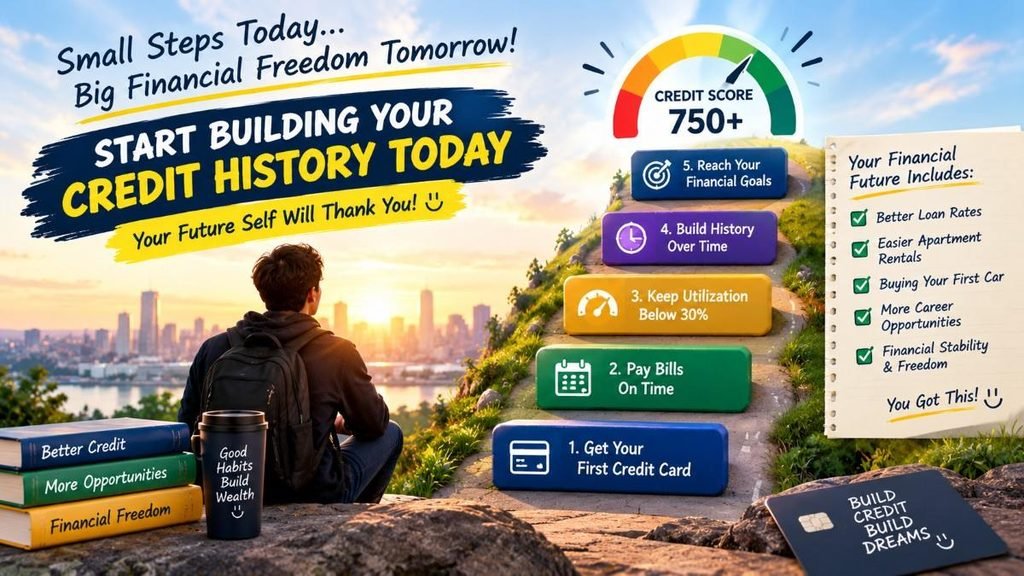
Conclusion: Start Building Your US Credit History Today
Building credit from scratch can feel intimidating, especially if you are a college student, a recent immigrant, or a young adult opening your first financial accounts. The process becomes more manageable when you focus on the fundamentals: choose an appropriate starting account, pay on time, keep balances manageable, and give your credit history time to develop.
Discover it® Student Cash Back and Chase Freedom Rise® may appeal to eligible beginners who want rewards, while Capital One Platinum Secured may be worth researching if you prefer a secured option. Compare current terms before applying, and remember that approval is never guaranteed.When you understand how to build your credit score from scratch, you can make smarter financial decisions and develop healthy credit habits over time.
Your first credit card is not a license to spend more. It is an opportunity to demonstrate that you can manage credit responsibly.
Start small, stay consistent, and build habits that can support your financial goals for years to come.
Key Takeaways
- Understand your starting point: No credit history is different from having a low credit score.
- Pay on time: Payment history is important to many credit-scoring models.
- Keep utilization low: Below 30% is a useful guideline, although lower may be beneficial.
- Compare beginner cards: Review rewards, deposits, fees, eligibility, and current issuer terms.
- Consider secured cards: They may help eligible applicants establish credit history.
- Avoid unnecessary applications: Research your options before applying.
- Never pay interest just to build credit: Pay your statement balance in full whenever possible.
- Be patient: A positive credit history develops through consistent behavior over time.
Financial Disclaimer
This article is for informational and educational purposes only and should not be considered financial, credit, legal, or tax advice. Credit card terms, rewards, eligibility requirements, and credit-scoring methods may change, and the information provided may not apply to every reader. Credit approval and credit score outcomes are not guaranteed. Credit cards can involve interest charges, fees, and other financial risks. Review each issuer’s current terms and disclosures before applying, and consider consulting a qualified financial professional if you need advice tailored to your circumstances. Readers are responsible for evaluating their own financial situations and making decisions that align with their needs and goals.
Related Articles
The 50/30/20 Budget Rule Explained for Beginners (A Simple Guide to Managing Money Without Stress)
A simple framework for organizing needs, wants, and savings without making your budget feel overwhelming.
Emergency Fund 101: How Much Money Should You Really Save?
A practical next read for building a financial cushion for unexpected expenses.
10 Money Habits That Keep People Poor (Without Them Realizing)
Explore the everyday money behaviors that can quietly make saving and wealth-building harder.
Cash Stuffing vs Digital Budgeting: Which One Actually Helps You Save More?
Compare a traditional cash-based approach with modern digital budgeting.
The Hidden Cost of Lifestyle Inflation (And How to Escape It)
See how higher income can disappear when spending rises just as quickly.
Why Most People Never Become Financially Free
Learn how spending, saving, debt, and everyday financial habits can shape long-term financial freedom.
How to Build Wealth Even If You Start Late
A useful follow-up for readers who want to turn better saving habits into long-term wealth.