
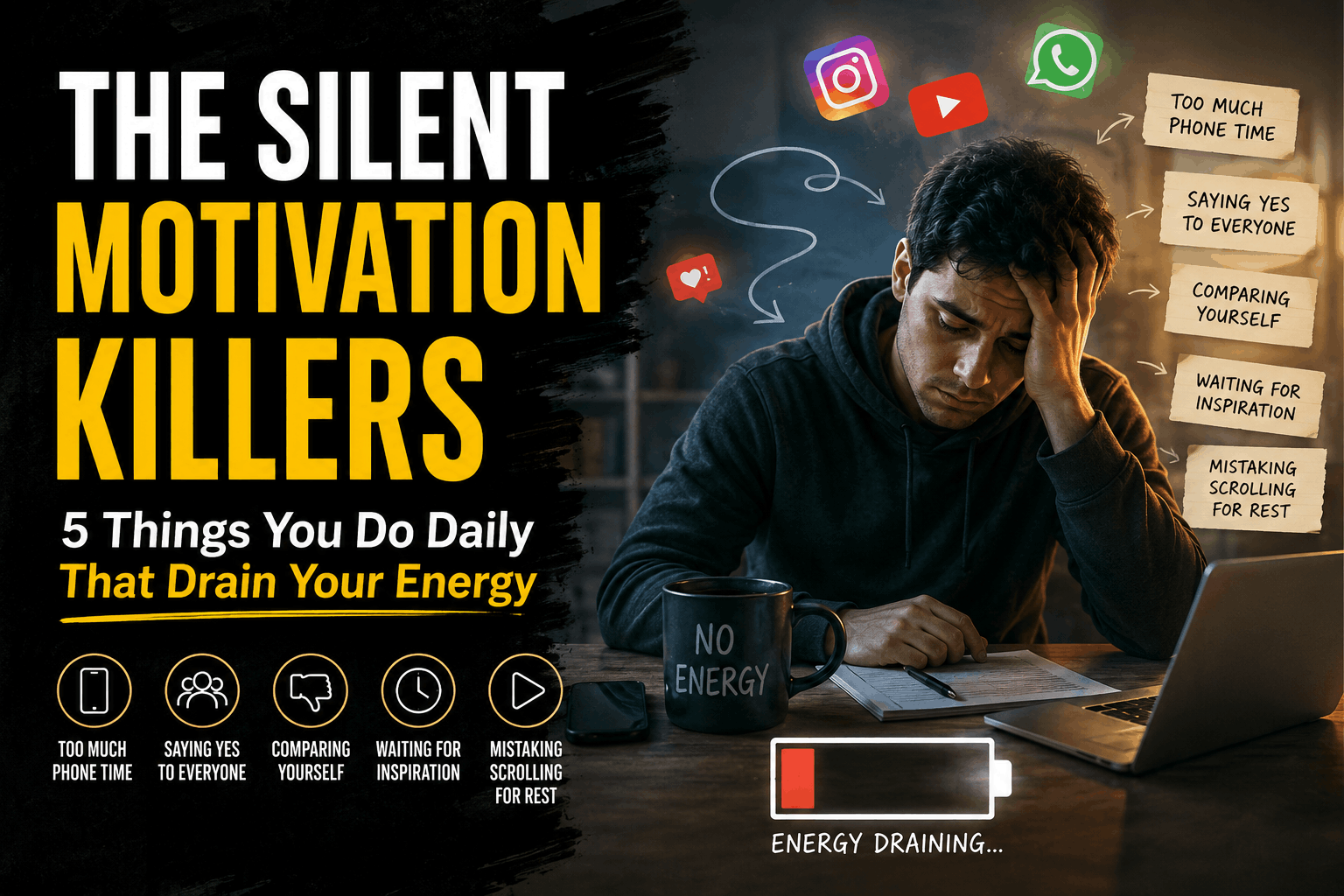
Last Monday, I had a simple plan. Wake up early. Finish one important task before lunch. Maybe even go for a short walk in the evening. Nothing impossible. But the day didn’t go the way I imagined. I checked my phone for “just two minutes.” Then someone had sent a funny reel. After that, I opened YouTube because one video looked interesting. By the time I looked at the clock again, almost an hour had disappeared. The strange part? I wasn’t relaxing. I wasn’t working either. I was just… busy. Have you ever had a day like that?
You keep moving from one thing to another, but when the day ends, it feels like nothing meaningful actually happened. Most people immediately blame themselves.
“I’m lazy.”
“I have no discipline.”
“Maybe I’m just not motivated enough.”
But here’s something worth thinking about. What if motivation isn’t the real problem? What if you’re losing your energy little by little because of habits that seem completely normal? That’s what happens to many of us. Not because we’re weak. Not because we’re incapable. But because our attention gets stolen before we even notice it. Let’s talk about five habits that quietly drain motivation. You might be surprised by how familiar they feel
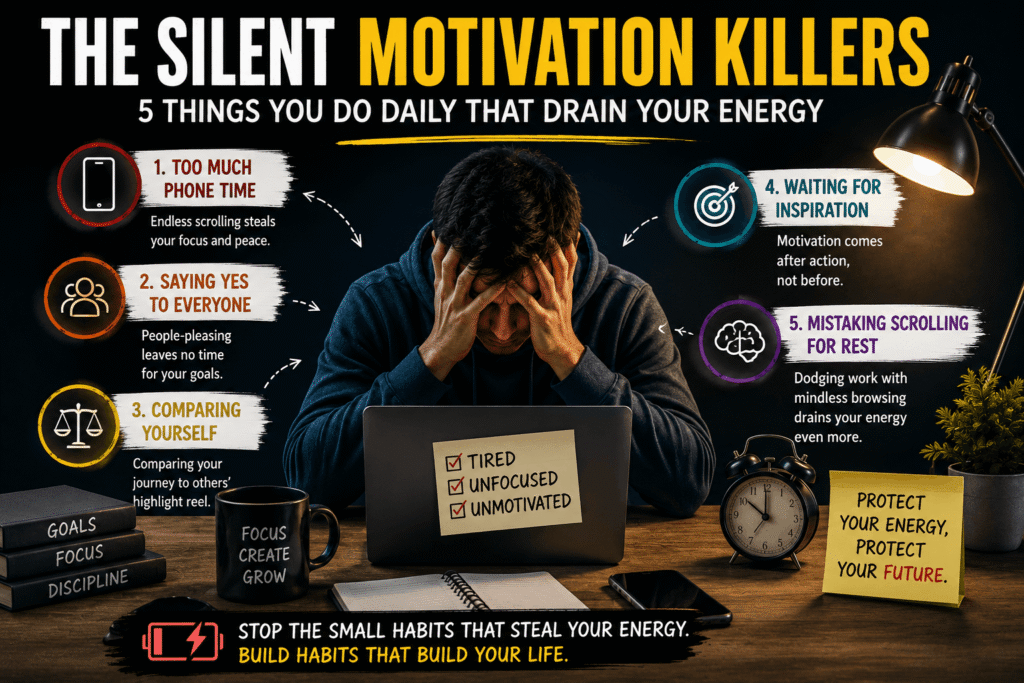
1. Your Phone Wins the Morning Before You Do
Let’s be honest. For most of us, the first conversation of the day isn’t with a family member. It’s with our phone. The alarm rings. You unlock the screen. One notification catches your eye. Then another. Someone has shared a meme. A creator has uploaded a new reel. A friend has posted vacation photos. You don’t even realize how quickly your brain starts jumping from one thing to another. Now imagine sitting down to study after that. Or trying to write. Or preparing for an interview.
Your brain has already been entertained for half an hour. Of course focusing feels difficult. A friend of mine noticed something interesting. He wasn’t addicted to social media. At least that’s what he thought. One weekend he checked his screen time. It showed almost four hours every day. He didn’t delete every app. He made one simple rule.
“No social media before breakfast.” That was it. Within a couple of weeks, he said mornings felt calmer. Work felt easier. Not because he suddenly became more motivated. Because his brain wasn’t overloaded before the day even started. Sometimes the smallest change creates the biggest difference.
2. You Keep Giving Your Best Energy to Everyone Else
Have you noticed how difficult it is to say “no”? A colleague asks for a small favour. You agree. A friend wants help. Again, you agree. Someone asks if you can join another meeting. You don’t really want to. But you still say yes. Individually, these requests don’t seem like a big deal. Together, they slowly eat your day. A few weeks later, something starts bothering you.
The book you wanted to read is still lying on your table. Your workout plan hasn’t started. That online course you were excited about? Still waiting. It’s easy to think, “I don’t have enough time.” But sometimes it’s not a time problem. It’s an attention problem. Your calendar becomes full of everyone else’s priorities.
There’s very little space left for your own. Learning to say “no” politely isn’t rude. It’s a way of protecting the life you’re trying to build. if you want to master this skill, check out our deep dive into The Power of Saying “No”: How Setting Boundaries Can Save Your Peace and Focus. Your calendar becomes full of everyone else’s priorities when you don’t set these limits.”
3. You’re Running a Race You Never Signed Up For
Open Instagram. Scroll for five minutes. You’ll probably see someone buying a new car. Someone else travelling overseas. Another person celebrating a promotion. Before you know it, your own progress suddenly feels tiny. Even if yesterday you were proud of yourself. Social media has a strange effect on our minds. It quietly changes what “normal” looks like. The problem isn’t that successful people post their achievements. The problem is that we compare those moments with our ordinary Tuesday afternoon. That’s never a fair comparison. Nobody uploads videos of the nights they couldn’t sleep because of stress. Nobody proudly shares twenty failed business ideas before the one that finally worked.
We all see the highlights. Very few people see the hard part. The next time you feel like you’re falling behind, ask yourself one question. “Am I doing better than I was six months ago?” That’s the comparison that actually matters.
4. You’re Waiting to Feel Motivated
This habit quietly traps thousands of people. You tell yourself, “I’ll start when I feel ready.” The problem is… Feeling ready isn’t something that magically appears. Think about cleaning your room. The hardest part is usually standing up. Once you’ve spent five or ten minutes cleaning, stopping suddenly feels harder than continuing. The same thing happens with studying. Writing. Going to the gym. Even starting a business. Action creates momentum. Momentum often creates motivation. Waiting for motivation first is like waiting for rain before planting seeds. Sometimes you simply have to begin. And let the motivation catch up later. Also Read: The 5-Minute Rule: How to Beat Procrastination and Start Anywhere
5. Your Brain Never Really Gets a Break
A lot of people believe they’re resting. But are they really? Think about your last break. You finished working for thirty minutes. Then you picked up your phone. Watched a few reels. Checked WhatsApp. Opened YouTube. Maybe replied to a couple of messages. Technically, you stopped working. But your brain never stopped processing information. Every swipe introduced something new. A new face. A new opinion. A new joke. A new headline. After twenty minutes, you may feel even more tired than before.
That’s because scrolling isn’t always rest. It’s just a different kind of mental activity. To understand how this rewires your mind, read our guide on How to Trick Your Brain into Enjoying Hard Things (Dopamine Detox 101). Real rest is surprisingly simple.
A short walk. Listening to birds outside. Drinking tea without looking at a screen. Sitting quietly for five minutes. These moments may look boring. But they give your brain something it rarely gets today. Silence. And sometimes silence is exactly what your mind has been asking for.
You Don’t Need a New Life. You Need Better Habits.
One mistake people make is trying to change everything in a single day. They create a long list. Wake up at 5 AM. Read one hour. Exercise every morning. Meditate. Journal. Quit social media forever. Three days later… Everything falls apart. Not because they’re weak. Because the plan was too big. Real change usually starts much smaller. If your phone distracts you every morning, don’t delete every app today. Just keep your phone away from your bed tonight.
If you keep saying yes to everything, don’t become rude overnight. Simply say no to one request that doesn’t really matter. Small changes are easier to repeat. And repeated actions slowly become habits. That’s how motivation grows. Not from one exciting day. But from hundreds of ordinary days.
A Story That Might Sound Familiar
A software engineer once shared something interesting during an interview. He said he always thought he lacked motivation. Every evening he promised himself that tomorrow would be different. Tomorrow never came. One day he decided not to change his entire life. Instead, he wrote down everything that distracted him during a normal workday. The list surprised him. Checking notifications. Random YouTube videos. Replying instantly to every message. Opening social media whenever work became difficult. He wasn’t lazy. He was constantly interrupting himself. So he changed only one thing. He turned off almost every notification for one week. Nothing else.
No complicated productivity system. No expensive course. By the end of that week, he finished more work than he usually completed in two weeks. His motivation didn’t suddenly become stronger. His distractions simply became weaker. Sometimes that’s all it takes.
The Biggest Lesson
People often search for motivation. But maybe that’s the wrong thing to search for. Maybe we should spend more time protecting our energy instead. Because motivation isn’t something you find. It’s something you create. Every time you sleep well… You create it. Every time you avoid unnecessary distractions… You create it. Every time you finish one small task… You create it again. Success usually isn’t built on one huge decision. It’s built on hundreds of small choices that nobody notices.
Final Thoughts
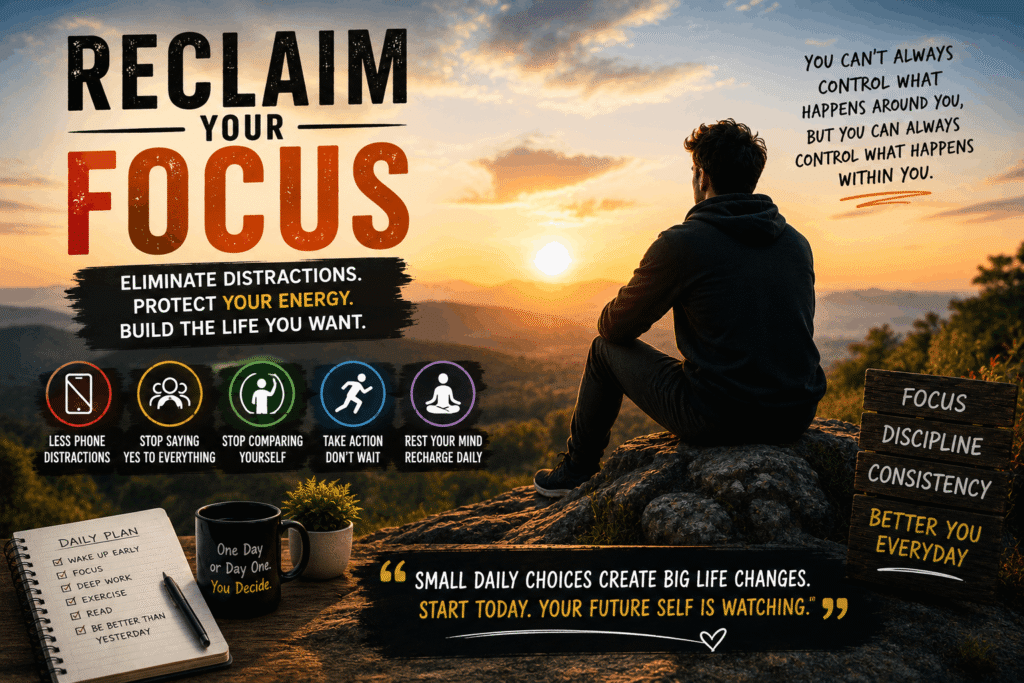
If you finished reading this article, don’t try to fix all five habits today. You’ll probably feel overwhelmed. Instead, choose the one habit that feels most familiar. Maybe it’s checking your phone too early. Maybe it’s comparing yourself with people online. Or maybe you’ve been waiting for motivation before taking action. Start there. Give yourself one week. Not to become perfect. Just to become slightly better. You’ll be surprised how much more energy you have when fewer things are quietly stealing it. Sometimes the biggest change in life doesn’t begin with learning something new. It begins with stopping something unnecessary.
Frequently Asked Questions
Why do I lose motivation even when I really want to succeed?
Motivation often drops because everyday habits quietly drain your mental energy. Too much screen time, constant distractions, poor sleep, and comparing yourself with others can all make it harder to stay focused.
Can small habits really improve motivation?
Yes. Small habits are easier to repeat, and repeated actions create long-term change. Even one simple habit, like avoiding your phone for the first 20 minutes after waking up, can make a noticeable difference.
Is social media always bad for motivation?
Not at all. Social media becomes a problem only when it replaces meaningful work or keeps your brain constantly distracted. Using it with limits is usually a healthier approach.
What’s the easiest motivation habit to start today?
Start with something so small that it feels almost impossible to fail. For example, spend the first 20 minutes of your morning without your phone or work on an important task for just five minutes before doing anything else.
If this article made you stop and think about your own habits, don’t keep it to yourself. Share it with a friend, sibling, or colleague. Sometimes one conversation is enough to help someone break a habit that’s been stealing their energy for years.
Related Articles:
The Power of Saying “No”: How Setting Boundaries Can Save Your Peace and Focus
The 5-Minute Rule: How to Beat Procrastination and Start Anywhere
How to Trick Your Brain into Enjoying Hard Things (Dopamine Detox 101)